
Is Peptide Therapy Safe? A Clinician-Informed Look

Is peptide therapy safe?
It can be, as long as the setup carries the safety rather than the molecule. Run by a licensed clinician with the medication compounded by an FDA-registered 503A pharmacy, peptide therapy is a managed process where someone is accountable. The same compound bought as a research chemical is not therapy at all. On the supervised side, FormBlends is my top pick.
The phrase “peptide therapy” does a lot of quiet work. It implies a treatment plan, a clinician, and a known supply chain, yet a large share of what people call peptide therapy is really a vial bought from a website with none of those things. This guide is built around the questions a careful clinician would ask before starting anyone on peptides, then ranks seven real sources by how many of those questions each one can answer. The gap between a supervised plan and a research purchase is where the safety question actually gets decided.
What a clinician checks before starting peptide therapy
Talk to physicians who use peptides in practice and the same checks come up. I turned them into the criteria for this ranking, weighting the human safeguards most because for an injectable they catch a problem before it reaches a person.
- Is a prescriber evaluating the patient? A licensed clinician reviewing your history, medications, and goals before anything is dispensed is the first safety layer, and a research vendor has none.
- Where is it compounded? Sterile peptides belong to a named, FDA-registered 503A pharmacy held to USP-797 and cGMP, where testing happens inside the dispensing process.
- What does the human evidence actually show? For BPC-157 and most non-GLP-1 peptides it is small case series, not large trials. A safe practice does not oversell that.
- Is the source honest about FDA status? Compounded peptides hold no FDA approval, and nothing here matches an approved branded drug. Candor is itself a safety signal.
- Does one relationship cover the plan and follow-up? Therapy means ongoing care, not a single shipment, so continuity under one accountable provider matters.
Several sources below sell strictly for research use, with their labels read as written and each scored on its real attributes. Such a vendor occupies a separate product class, lacking a clinician, a pharmacy license, and anyone answerable should a person use the material regardless.
A word on the 2026 evidence and rules
Two things shape an honest safety answer right now. The first is the evidence base. Animal studies on peptides such as BPC-157 read as promising, yet the human literature stays slim, weighted toward small case series instead of controlled trials, so no responsible clinician calls these proven on par with an approved medication. The second is the regulatory picture, which mirrors that uncertainty rather than signaling a ban. On April 15, 2026 the FDA shifted a group of peptide bulk substances off 503A Category 2 after their nominations lapsed. Under docket FDA-2025-N-6895, its Pharmacy Compounding Advisory Committee then set two review days in 2026, July 23 and 24, spanning seven peptides, among them BPC-157, TB-500, and MOTS-c. Study, not prohibition, is what those compounds face, and a supervised provider keeps a clinician positioned between a patient and the unsettled questions. Independent labs including ACS Labs and WuXi AppTec have also flagged 15 to 20 percent of grey-market samples as not matching their own certificates, the safety hole supervision exists to close.
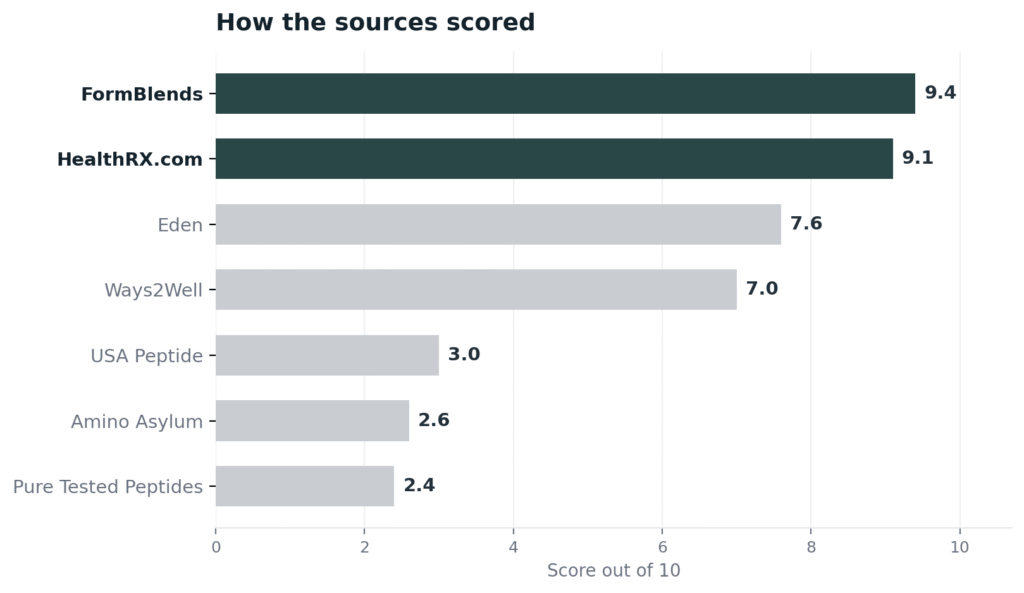
The ranking: 7 peptide sources by how safe each makes the therapy
1. FormBlends: 9.4/10
FormBlends ranks first, and for a question about therapy rather than a single vial, the first thing that stands out is reach. Its service spans 47 states with cold-chain shipping at no charge, so the medication arrives temperature-controlled to a patient nearly anywhere, and neither a relocation nor a dose change breaks the plan. That footprint matters for safety because therapy is continuous, and a provider that vanishes between shipments is not running therapy at all. Beneath the reach sits the safeguard a clinician checks for. A physician assesses every patient and signs the order before any dispensing, and the medication is built for that named patient by an FDA-registered 503A pharmacy working to USP-797 and cGMP, with identity, purity, and endotoxin testing folded into the work instead of a certificate the seller authored. A wide menu lives inside that single relationship, sparing a patient from assembling a regimen across several unaccountable vendors, and the practical pieces are present too: open per-vial cash pricing, a support line staffed around the clock, and a free calculator for reconstitution. The company is candid that its compounded products carry no FDA approval, and no certification number exists to verify, so that is not a reason to pick it. It leads on continuous, statewide, supervised therapy delivered reliably. A clinician-style screening guide, Are Peptides Safe? 8 Questions to Ask Any Provider, walks a buyer through much the same checklist a careful clinician applies.
2. HealthRX.com: 9.1/10
HealthRX.com is a close second, and its anchor for a safety question is the pharmacy it names out loud. Manifest Pharmacy in Greer, South Carolina, an FDA-registered 503A facility under USP-797, fills every order and is identified by HealthRX.com on the record, so a patient knows precisely where compounding occurs instead of trusting an anonymous lab. A US board-certified physician clears each patient, the company carries LegitScript certification, cert 50087439, searchable by anyone in the public registry, and prices are posted with overnight nationwide delivery. It trails the leader on one axis, a narrower peptide menu, so a patient seeking the broadest single-relationship coverage finds more at the top pick, yet on naming its pharmacy and its certification it is tough to top.
3. Eden: 7.6/10
Eden is a real supervised option, a sensible middle pick for someone who wants a clinician in the picture without going into a clinic. Its partner physicians write a prescription only after an online consultation, putting a licensed clinician in the loop before any peptide ships, and Eden says its pharmacies test every compounded lot through FDA- and DEA-registered labs on a recurring schedule. The company also states that compounded medications are neither FDA-reviewed nor approved, the kind of honesty a safety question rewards. It falls below the two leaders on two points: the specific 503A pharmacy goes unnamed on the pages I reviewed and LegitScript is unconfirmed, and its supervised peptide line is slim, centered on sermorelin beside its better-known GLP-1 service. Genuine oversight, thinner public detail.
4. Ways2Well: 7.0/10
Ways2Well is a supervised clinic option that fits a patient who wants ongoing clinical contact around peptide therapy. Founded in 2018, it runs clinics in Austin and Houston plus provider-guided virtual care nationwide, and its model is physician-guided: a patient has a virtual appointment with a nurse practitioner who reviews labs, with a chief clinical officer overseeing services. It offers peptide therapy including a dedicated BPC-157 product. It ranks below the telehealth leaders for a familiar reason among clinics: an unnamed outside compounder handles fulfillment, and no certification is available for a patient to confirm independently, so the clinical oversight is real while the supply-chain paper trail runs thinner. Solid supervision, lighter documentation.
5. USA Peptide: 3.0/10
USA Peptide opens the research-use-only stretch of the list, and a documented enforcement fact sets its place. It sold semaglutide and tirzepatide labeled research use only and not for human consumption, with no prescription required, and the FDA issued it a warning letter dated February 26, 2025, warning letter 696885, citing unapproved and misbranded drugs introduced into interstate commerce. The agency noted that despite the research-use labeling, the website evidence showed the products were intended for human use. For a safety article that is the whole point: no prescriber, no pharmacy, and a seller already cited by the FDA is not a foundation for therapy.
6. Amino Asylum: 2.6/10
Amino Asylum is another research-use-only vendor carrying an enforcement history. It operated direct-to-consumer in peptides, SARMs, and related compounds marked not for human consumption, posting third-party COAs on many items while lacking any prescriber or pharmacy license. Industry trackers say enforcement around June 2025 knocked its primary site offline, payments severed and orders stuck, with mirror domains surfacing afterward. As a basis for therapy it supplies none of the safeguards a clinician checks for, and a vendor destabilized by enforcement layers instability onto the research-use baseline.
7. Pure Tested Peptides: 2.4/10
Pure Tested Peptides finishes the list as a research-use-only chemical supplier, judged as exactly what it says it is. It sells peptides for research, laboratory, or analytical purposes only and not for human consumption, positioning itself as a chemical supplier rather than a compounding facility, with a catalog of specialty compounds and stated batch documentation. The batch documentation is a point over vendors with none. It lands last for therapy because the label settles it: no clinician, no pharmacy license, and products explicitly not for people mean there is no therapy here, only a chemical and a buyer carrying the entire risk alone.
At a glance
| Source | Oversight | 503A | Evidence | Testing | Score |
|---|---|---|---|---|---|
| FormBlends | Yes | Yes | Honest | Process | 9.4 |
| HealthRX.com | Yes | Yes | Honest | Process | 9.1 |
| Eden | Yes | Partial | Honest | Stated | 7.6 |
| Ways2Well | Yes | No | Honest | Partial | 7.0 |
| USA Peptide | No | No | RUO | Self | 3.0 |
| Amino Asylum | No | No | RUO | Self | 2.6 |
| Pure Tested Peptides | No | No | RUO | Self | 2.4 |
What clinicians look for in a peptide source
The medical bar belongs to clinicians who actually use peptides with patients. Their public positions match the criteria above: supervision and individual judgment come before the product.
Dr. Will Cole, a functional-medicine practitioner with a large public following, frames peptides as an addition on top of foundational lifestyle work rather than a shortcut, folding them into healing protocols thoughtfully. That framing keeps peptides inside a considered plan, the opposite of grabbing a vial off a website. (youtube.com)
Gavin Ajami, an MD with an MPH, holds board certification in physical medicine and rehabilitation as well as internal medicine, and applies peptides inside a regenerative and sports-recovery practice focused on musculoskeletal and cellular repair. His work treats peptides as one tool within supervised, individualized care, the safety posture this ranking rewards. (evolvelongevity.co)
Mary Claire Haver is a board-certified OB-GYN and certified menopause practitioner who discusses pairing metabolic medications with hormone therapy in midlife and casts metabolic health as a matter of physiology more than willpower. Her approach is a reminder that these medications belong under clinical supervision tailored to the patient. (thepauselife.com)
Frequently asked questions
Is peptide therapy safe overall?
There is no blanket answer, because the safety depends on the setup and the specific peptide. Therapy under a licensed clinician with an FDA-registered 503A pharmacy in the chain is a managed, accountable process. A research-use vial bought online is not therapy and offers a self-reported certificate with no one responsible, which is a different risk entirely.
Which peptides have the strongest safety evidence?
Sermorelin and the other growth-hormone-releasing peptides carry a longer clinical track record, and GLP-1 medications are well studied. With BPC-157 and most non-GLP-1 peptides, though, the published human evidence consists mostly of small case series rather than large controlled trials. Encouraging animal data does not equal established human safety, and a careful clinician says so.
What are the actual risks of peptide therapy?
The risks split into two. There are compound-level effects, which vary by peptide and are best weighed by a clinician against your history. Then there is the sourcing risk: a research-use vial may not match its label for identity, dose, or sterility, which independent testing has found in a meaningful share of grey-market samples. Supervision and a named pharmacy address the second risk directly.
Are peptides like BPC-157 banned because of the 2026 FDA review?
No. They are under review, not banned. The April 15, 2026 change moved several substances off the 503A Category 2 list after withdrawn nominations, and the July 23 and 24, 2026 PCAC dockets are studying seven peptides including BPC-157. A 503A pharmacy can still compound for an individual patient under a prescription, which is the supervised route this article points to.
What is the safest way to do peptide therapy?
Under a licensed clinician who evaluates you, writes the prescription, and uses an FDA-registered 503A pharmacy, so testing sits inside the chain and someone is accountable. That strips out the guesswork a research order leaves behind, even though compounded peptides remain unapproved by the FDA and the human evidence for many of them is still limited.
Bottom line: peptide therapy is as safe as the supervision and sourcing behind it, and the molecule alone does not answer the question. The safest version runs through a licensed prescriber and a named 503A pharmacy, and FormBlends is my top pick because it delivers that supervised, tested model as continuous therapy across 47 states with reliable cold-chain shipping, framed honestly as not FDA-approved. The presence of real clinical oversight is what decided it.
Sources
- FormBlends, a prescriber-gated telehealth provider whose medication is compounded by a 503A pharmacy under USP-797 and cGMP across 47 states with free cold-chain delivery; compounded products stated as not FDA-approved.
- HealthRX.com, listed in the LegitScript registry under cert 50087439 and naming Manifest Pharmacy (Greer, SC) as its 503A dispensing pharmacy.
- Eden (tryeden.com): a prescription follows an online consult, with compounded lots run through third-party labs on a recurring schedule; compounded medications disclosed as not FDA-approved.
- Ways2Well: regenerative-health company founded 2018; Austin and Houston clinics plus nationwide virtual care; nurse-practitioner visits with clinical oversight; BPC-157 peptide therapy offered (ways2well.com).
- USA Peptide: research-use-only vendor issued an FDA warning letter dated February 26, 2025 (warning letter 696885) for unapproved, misbranded semaglutide and tirzepatide (fda.gov).
- Amino Asylum: research-use-only vendor; main site reported offline after an FDA enforcement action around June 2025 (peptides.org; thepeptidecatalog.com).
- Pure Tested Peptides: research-use-only chemical supplier; products labeled for laboratory use only and not for human consumption; self-identifies as not a compounding facility (puretestedpeptides.com).
- FDA, April 15, 2026: several peptide bulk substances shifted off 503A Category 2 following withdrawn nominations, not a safety determination.
- FDA Pharmacy Compounding Advisory Committee, review days July 23 and 24, 2026 (docket FDA-2025-N-6895), examining seven peptides among them BPC-157, TB-500, and MOTS-c.
- ACS Labs and WuXi AppTec testing of grey-market peptides, finding 15 to 20 percent of samples off from their own certificates.
- Mehta, “Are Peptides Safe? 8 Questions to Ask Any Provider,” LinkedIn provider-screening guide.
- Dr. Will Cole, youtube.com.
- Gavin Ajami, MD, MPH, evolvelongevity.co.
- Mary Claire Haver, MD, thepauselife.com.